
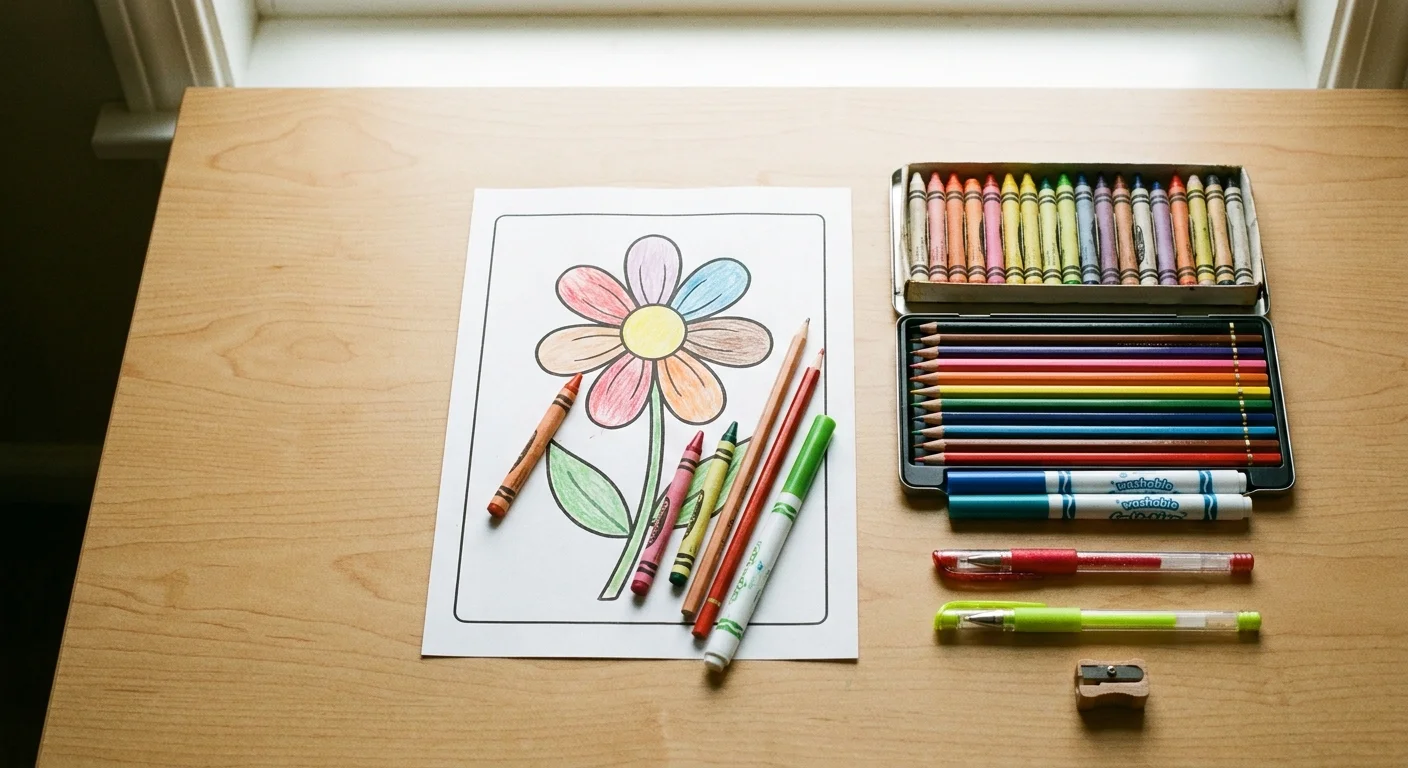
Print the fire truck with its ladder up three times and hand out three different tools. With crayons it comes back red, fast, with the ladder rungs colored straight over. With colored pencils it takes twenty minutes and the tires have a shine. With washable markers it is the brightest of the three and the back of the sheet is pink. None of those is wrong. Each tool is good at one kind of page and bad at another, and most of the frustration at the coloring table comes from the mismatch.
This is what each tool does well, what it does badly, and which of our pages to hand it with.
Wax crayons
Crayons are wax with pigment in it. The wax is what makes them the right first tool: they do not bleed, they do not run out, a dropped one survives, and a two-year-old can make a mark with no pressure at all. For hands under five, the jumbo triangular kind is worth the extra money. The triangle stops it rolling off the table and forces something close to a proper grip; the thickness stops it snapping the first time it gets stabbed into the paper.
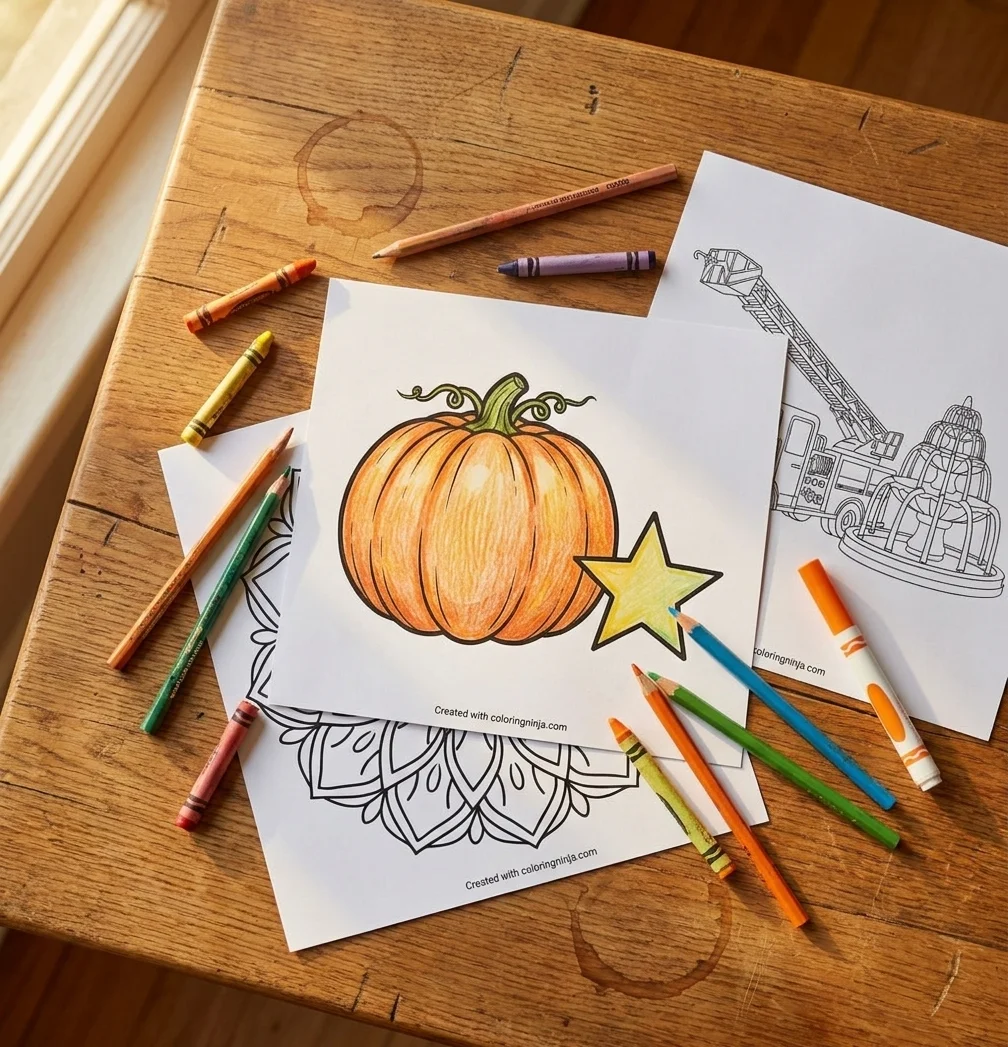
What crayons cannot do is detail. The tip goes flat after the first page and a flat tip cannot stay inside a small shape. So give crayons the pages with big open areas and few lines: a large pumpkin next to a star, a round frog with a crown, a school bus with big windows. Two things to show a child once: the side of a crayon, not the tip, covers a sky in three strokes; and a light color rubbed over a dark one makes a third color, which is the first thing about mixing most kids ever learn.
Colored pencils
Colored pencils are the tool for anything with small shapes or thin lines, and the only one of these tools that can make a gradient. Press lightly and you get a pale wash; press harder in the same spot and it darkens; put a second color over the first and they mix on the page. That is what a floral mandala or a snowflake made of fine symmetrical lines needs, and it is why the owl looks so different in pencil than in crayon: the pencil can follow the direction of the feathers.
There are two kinds. Wax-based pencils (most school sets) are soft, lay down color fast and are easy for kids to use, but the points wear quickly. Oil-based pencils are harder, keep a point, and are better for fine work and for older kids, but they take more pressure to get a strong color. A set of 12 covers everything; a set of 24 is nicer and not necessary. The one accessory that matters is a sharpener with a reservoir, because a blunt colored pencil is a crayon with worse coverage, and shavings on the carpet end coloring time early.
The other thing pencils have going for them: they work on ordinary printer paper. No bleed, no buckling, no cardstock needed. Whatever comes out of the printer from our Print PDF button is the right paper for pencils.
Watercolor pencils
Watercolor pencils look like colored pencils and behave like them until you touch the page with a wet brush. Then the color dissolves and spreads into a wash. For a child who has outgrown crayons but is not ready for paint, they are the bridge: color the sky in pencil, brush water over it, and it becomes an actual sky. They need heavier paper than the printer holds, so print the page on cardstock or glue it to something thicker first; ordinary copy paper wrinkles as soon as it is wet. And they are not for pages with lots of thin lines, because the wash goes where the water goes, not where the lines are.
Washable markers
Markers give the flattest, brightest color of any tool and they do it without pressure, which is why kids reach for them first and why teachers hide them. Broad-tip markers cover a big area in seconds; fine-tip ones are for outlines and small shapes. Both bleed through 20 lb printer paper, so either print the page on 65 lb cardstock or put a spare sheet underneath the page before anyone starts. The word washable on the box is not decoration: it is the difference between a table that wipes clean and one that does not.
Markers want the same pages crayons want, big shapes and few lines, but they punish something crayons do not: staying in one place. A marker held still for two seconds makes a dark wet spot that soaks through. So the fire truck and the elephant on the savanna road are marker pages; the mandala is not. The other rule is caps. A marker with the cap off for an afternoon is a marker in the bin. The trade works: no new color until the old cap is clicked on.
Alcohol markers
These are the markers illustrators use: alcohol-based ink that blends smoothly, refillable, sold one at a time at a price that makes a set of school markers look free. They are for teenagers and adults, not for a six-year-old, and they need the paper more than any other tool on this list. Alcohol ink goes straight through copy paper and through cardstock too, so the page goes on a spare sheet or a marker pad, and the finished result is worth it: two blues blended into each other on the snowflake look like nothing a pencil can do. If you are printing a page for someone with alcohol markers, print it on the heaviest paper the printer takes and at the highest quality setting, because those inks show every jagged line.
Gel pens and fineliners
Gel pens are not a coloring tool. They are the tool for after the coloring: a white gel pen puts the shine back into an eye that got colored over, a metallic gold does the baubles on the Christmas tree, a glitter pen does the wand on any fairy. Older kids who have finished a page and want to keep going will fill the background with patterns in gel pen for as long as you let them.
A black fineliner earns a place in the box for one reason: fixing outlines. When a crayon has gone over a line and the shape is lost, a fineliner puts the line back on top. It is also what an older child uses to add their own details to a simple page, which is the natural next step after coloring inside someone else’s lines.
The paper decides half of it
Every page on the site has a Print PDF button, sized for Letter and A4, and what you load in the printer changes which tools work on it. Ordinary 20 lb copy paper is right for crayons and pencils and wrong for markers. 65 lb cardstock is right for markers, watercolor pencils and anything wet, and it also survives a small child better. If you only ever print on one paper, make it cardstock and you never have to think about it again. The rest of the printing questions (faint lines, tiny pages, the margins getting clipped) are in our guide to printing coloring pages, and matching tools to a child’s age is covered in how to choose coloring supplies for kids.
If you are starting from nothing, this is the box that covers everyone from two to twelve:
- A box of 8 jumbo triangular wax crayons (under five)
- A set of 12 wax-based colored pencils and a sharpener with a reservoir (five and up)
- A pack of 8 to 12 washable broad-tip markers (any age, on cardstock)
- A white gel pen and a black fineliner (for fixing and finishing)
- A stack of 65 lb white cardstock for the printer
Ready to Make Your Own?
Describe any idea and get a free, printable coloring page in seconds.
Try the Coloring Page GeneratorPrint the fire truck on cardstock, put crayons, pencils and markers on the table, and let the kid pick. The tool they reach for tells you what kind of pages to print next.