

Watch a three-year-old hold a crayon. The whole fist wraps around it, the elbow does the work, and the color goes wherever the arm goes. Six months of coloring later, the crayon has moved to the fingertips and the wrist is doing the steering. Nobody taught that. The page did.
That is the honest version of what coloring pages are good for. Not miracles, not “brain development” in the abstract, but ten specific, ordinary things that happen when a kid sits down with a page and a box of crayons. Here they are, with the page we’d hand over for each one.
What a crayon does to a small hand
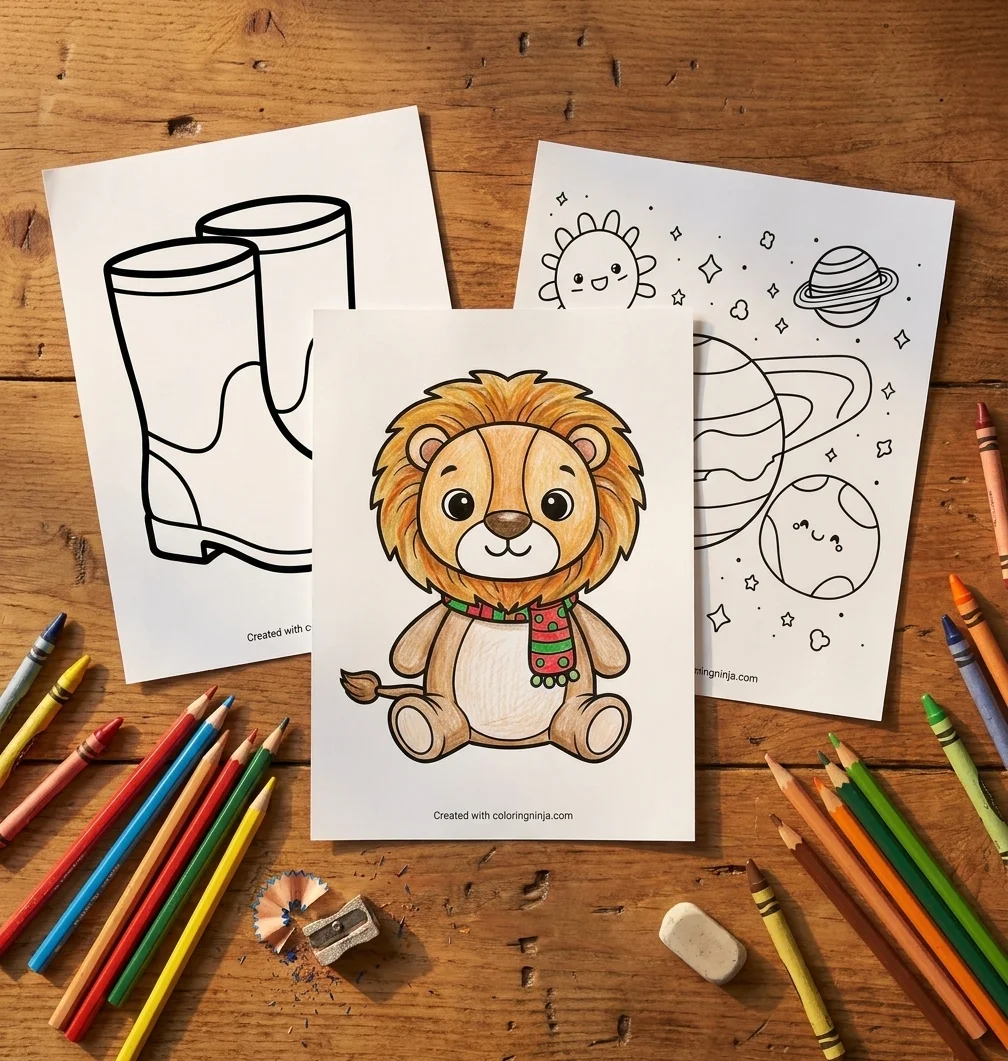
1. Grip and hand strength. Filling in a big shape takes a few hundred small strokes, and every one of them works the muscles that will later hold a pencil. For a kid still coloring from the elbow, start with a page that’s mostly one shape: a pair of rain boots or a round little frog with a crown. Big areas, thick outlines, nothing fiddly. The fingertip grip shows up on its own once the hand gets tired of the fist.
2. Eyes and hands working together. Staying inside a line is harder than it looks: the eye has to spot the edge coming and the hand has to slow down before it gets there. A page with a few clear boundaries is the whole exercise. A dog holding a cup of tea has a body, a cup, two ears and a patch over one eye, and that’s five edges to notice. When the coloring starts stopping at the lines, the page has done its job. Move up to a butterfly with wide-open wings, which has the same idea with more edges.
Twenty quiet minutes
3. Attention. Most things a five-year-old does last about ninety seconds. A coloring page is one of the few that stretches to twenty minutes without anyone asking, because there is always one more petal to fill. A floral mandala is built for this: it repeats outward in rings, so the next thing to color is always obvious and the end is always in sight. Older kids and adults get the same effect from a forest café full of bears and foxes drinking coffee under paper lanterns, which takes closer to an hour.
4. Calming down. Coloring is repetitive on purpose. Same motion, small area, no decisions bigger than “blue or green.” That’s why it works after school, before bed, or in the twenty minutes between a tantrum and dinner. We’re not going to tell you it fixes anything, but it changes the pace of a room, and sometimes that’s all you need. A snowflake with fine, symmetrical lines is the one we’d pick for that: quiet, slow, and impossible to rush.
Every page is fifty small decisions
5. Choices. The lines are given; the colors aren’t. A dragon can be purple. The sky can be orange. On a dragon flying over the mountains, a kid decides the color of the wings, the belly, the volcano and the clouds, and each of those is a small creative call made without anyone watching. Kids who won’t draw a thing on a blank sheet will happily make fifty decisions on a page that already has the outlines.
6. Color names, and what colors do. Somewhere between “the yellow one” and “that’s more of a gold,” kids learn that colors have names, that two of them make a third, and that pressing harder makes it darker. A cartoon solar system with a smiling sun and ringed planets is a good page for this, because every planet is an excuse for a different color and the sun wants two.
Finishing something you can hold
7. Done is a feeling. A lot of what kids do all day has no clear end. A coloring page has one: the last white bit gets filled in, the page comes off the table, it goes on the fridge. That small, physical “I finished it” is worth more than any praise you can add on top. For a kid who tends to abandon things halfway, pick a page that can be finished in one sitting, like a soft lion plush with a scarf, and let the finishing do the talking.
Letters and names, without a worksheet
8. Letters that don’t feel like homework. A worksheet says “trace the letter A.” A big fat letter A says “color me in,” and the kid traces the edge of it twenty times without noticing. We keep a whole section of letter pages for this, but the one that works best is the child’s own name. The name Lucas, with flowers and swirls inside each letter gets colored by a Lucas with a concentration you will not see on a worksheet. If your kid’s name isn’t in the name pages yet, the generator on our homepage will make it from a sentence like “the name Maya with stars around it.”
The talking that happens over a page
9. Words. Put a rainforest with a monkey, a toucan, a jaguar and a waterfall in front of a four-year-old and you will hear the words monkey, toucan, jaguar and waterfall in the next five minutes, plus a question about what jaguars eat. A busy scene page is a picture book the kid gets to finish. A cozy vintage kitchen does the same thing with pots, a stove, a loaf of bread and a window, and it comes with a conversation about what’s cooking.
10. Doing something next to each other. This is the one people forget. Coloring is one of the few activities where an adult and a kid can sit at the same table, work on their own thing, and still be together. Nobody has to win. Print two copies of the same page and see how differently they turn out, or upload a photo of the family dog to the photo tool and color your own dog side by side. That page will outlast every worksheet in the house.
If you want one page to start with, print the rain boots. It covers the first three things on this list for a small kid, it takes ten minutes, and it goes on the fridge. Then come back for the mandala.
Ready to Make Your Own?
Describe any idea and get a free, printable coloring page in seconds.
Try the Coloring Page Generator